Wednesday, January 13, 2010

When You Reach Me by Rebecca Stead

when The first note that Miranda received stated, among other things:

I am coming to save your friends life, and my own.

You must write me a letter.

The trip is a difficult one. I will not be myself when I reach you.

The third note provided proof to Miranda that the person writing these mysterious notes came from the future. The letter that Miranda writes becomes the story told in When You Reach Me. It details the things that happened to Miranda that fall and winter, things both mundane and extraordinary. The time traveling aspects lend a unique touch to an otherwise realistic story. The story flows so smoothly that I had a hard time putting the book down. Readers who want to figure out who’s writing the notes will probably be able to do so, but that in no way detracts from an otherwise near-perfect book. Review by Katie Corrigan

Saturday, January 02, 2010

The Last Newspaper Boy in America by Sue Corbett

last newspaper I enjoyed this book so much!  Sue Corbett manages to tell a story about a quirky family that’s funny, but not so over the top as a lot of recent books.  In Wil’s family, your 12th birthday is momentous because that’s when you get to take over the paper route that’s been in the family for generations.  “…every paper ever flung onto a porch in Steele had flown from the hand of somebody named David.” Wil has been training for years, and is probably the best newspaper tosser the family has ever seen.  And for Wil the route is doubly important because he wants to use the money he earns to buy his own computer, so it’s quite a set-back when he finds out the night before his birthday that the publisher of The Cooper County Caller is going to stop home delivery of the paper in his hometown.  At the same time, the fair has come to town.  Over the past few years, Wil has figured out the gimmick to each of the games at the fair, and why the competitors never win big, but this year there’s a new game called Cover the Spot.  The prize is $1000 and the game involves throwing.  If Wil can win the game he’ll have enough money to buy his computer.  He spends the first couple of days observing, because you can only play once.  When he finally has an idea of how the fair is rigging the game, it takes the help of lots of people to expose the cheating in a public enough way to make sure that he wins the $1000.  Along the way he gets an idea to help the town attract a new business to take the place of the factory that’s closing caused such financial hardship for just about everyone in town.  There are plenty of entertaining side bits and characters. Review by Stacy Church

Wednesday, December 30, 2009

The Doom Machine by Mark Teague

doom Things are getting very strange in the sleepy town of Vern Hollow. It’s 1956 when Jack Creedle sees the flying saucer overhead. Not everyone believes that aliens have landed, so Jack and his new friend Isadora set out to prove it. Sure enough, the huge spider-like aliens known as Skreeps are there, and they’ve come looking for the secret invention that Jack’s Uncle Bud has created. When Jack and Isadora almost thwart the aliens’ plans, they find themselves kidnapped and taken aboard the spacecraft, along with Uncle Bud and Isadora’s scientist mom. This is quite the adventurous tale, with Jack and Isadora escaping from the Skreeps and traveling to different planets, all in an attempt to keep Uncle Bud’s dangerous creation out of the Skreeps’ hands. The characters are interesting, especially the ruthless Skreep commander Xaafuun. I thought that the book was a little too long because it started to lose me at the end, but all-in-all I thought this was an exciting sci-fi adventure! Review by Katie Corrigan

Wednesday, December 16, 2009

The Evolution of Calpurnia Tate by Jacqueline Kelly

evolution I know a book is good if I don’t want it to end, and that is definitely how I felt about this one. With one chapter left, I found myself putting the book down to finish the next day. I wanted to put off saying goodbye to Calpurnia, her family, and her interesting life. Eleven-year-old Calpurnia Virginia Tate lives in Texas, and is smack-dab in the middle of three older brothers and three younger brothers. During the hot summer of 1899, she starts to explore the animals and plants near her home. Her grandfather, impressed with this, shares his own nature observations with her, and shows her the correct way to make scientific observations in her notebook. But not everyone is pleased with Callie’s new hobby. Her mother thinks she should spend more time learning needlework and cooking, in preparation for when she’ll one day be a wife. This is a charming and humorous story of a girl on the verge of growing up, and not sure if she’s ready to. Callie’s brothers are also growing up, learning that it’s best not to make pets out of farm animals, and developing crushes on Callie’s best friend. The rest of Callie’s family is as interesting as she is, making for a book that is hard to put down, and hard to finish. Review by Katie Corrigan

Tuesday, December 01, 2009

Al Capone Shines My Shoes by Gennifer Choldenko

al One of the things I like the best about this sequel to Al Capone Does My Shirts is that things and people are rarely black and white, except in the end, of course.  Moose encounters lots of people in his life on Alcatraz Island in 1935: a mean guard, Officer Darby, who seems to have it in for him; Al Capone himself, who is calling in the favor Moose owes him from the previous book; Willy One Arm and Buddy Boy, two convicts that work at the warden’s house; Piper, the warden’s daughter, who Moose has a love/hate relationship with.  It’s hard for Moose to tell who he should trust.  HIs instincts are pretty good, but the thing that continues to get him in trouble is that he wants to make everyone happy.  His sister, Natalie is away at a special school on the mainland, and though everyone says it’s good for her, Moose isn’t too sure.  The conclusion of the book is very exciting, and involves guns, kidnapping, and an attempted prison escape.  Review by Stacy Church

Wild Girl by Patricia Reilly Giff

wild This is a book that really drew me in. Although I wasn’t crazy about the chapters told from the young horse’s perspective, the chapters told from Lidie’s viewpoint just got better and better as the book went on. At the beginning, Lidie is getting ready to leave Jales, Brazil, where she has been living with her aunt and uncle for the past 5 years. Her father and brother moved to the US after her mother died, but they couldn’t take her with them. Even though she is angry at having been left behind, she loves her home, the countryside, her aunt Titia Luisa and even her Uncle Tio, who she has a stormy relationship with, and especially riding the neighbor’s horse wildly through the fields. When she arrives in New York, she is angry to discover that her father and brother expect her to be the same 7-year-old girl they left behind in Brazil (not realizing that she expects them to be the same also). She doesn’t speak much English, and school turns out to be humiliating when she can’t make the teacher understand that she needs to go to the bathroom. She wets her pants and then runs away from school, swearing to herself never to return. It takes a while for things to improve for Lidie, but the world of horses that surrounds her (her father runs a stable and her brother is a budding jockey) draws the family together and when the filly whose voice narrates the alternating chapters comes to the stable, Lidie recognizes a kindred spirit. There are exciting scenes from the racetrack, and it’s nice to see that Lidie loves the old horse her father bought for her to learn to ride on, even as she resents that he thinks she could only ride such a broken-down old horse. Review by Stacy Church

Friday, November 27, 2009

Funny Business: Conversations with Writers of Comedy edited by Leonard S. Marcus

 funny business This book is a great opportunity to learn more about your favorite writers: Judy Blume, Beverly Cleary, Sharon Creech, Daniel Handler…Included along with each interview is a manuscript page with mark-ups, a bibliography of the author’s works, and, of course, pictures.  I found some of the interviews more interesting than others, and they weren’t necessarily the authors I was the most curious about.  I learned some really interesting things, like the fact that Christopher Paul Curtis (The Watsons Go to Birmingham,  Bucking the Sarge) worked on the assembly line at General Motors for 13 years before he ever started writing.  Daniel Handler talked quite a bit about the Holocaust –his father left Germany to avoid the Holocaust, and many other family members didn’t make it out.  A number of the authors had no support or encouragement for their talents growing up, and some others remember an important teacher or other adult during their childhood who nurtured their talent.  One of my favorite stories is from Judy Blume, about how her character Fudge is based on her son Larry. “Fudge is thirty-five now.  Larry is forty-four.  So it’s a long time ago that he was Fudge-like.  But we met a little boy the other evening whose father reads him Fudge every night.  We were at this boy’s grandma’s house having dinner.  His father said to him, ‘Do you know who this is?  This is Judy Blume, who writes the Fudge books.’  The little boy’s mouth just dropped, and then he came over to me and kind of petted my arm.  Then I said, ‘And guess who this is?’ pointing across the table to Larry.  Larry said, ‘I was Fudge.’  The little boy just couldn’t believe it.  He said, ‘Oh!’  and now he calls Larry ‘Fudge.’  Review by Stacy Church

Wednesday, November 18, 2009

The Unfinished Angel by Sharon Creech

unfinished Do you believe in angels?  With this story you can travel to Switzerland to a remote village nestled high in the Alps, and meet one!  The angel lives in the ancient stone tower of Casa Rosa.  When Zola arrives from America, she is amazed to discover the angel in her new home.  Promptly she asks the angel all kinds of questions, like: Who are you? Are you a boy or a girl angel? Are you all-knowing and powerful?  Zola is not impressed when she hears that the angel has been living in the tower for hundreds of years and likes everything in the village just the way it is.  Zola quickly gets to know the villagers.  Then she surprises a group of orphans hiding in an old barn.  Now Zola is on a mission!  She sets out to help the children, and she pesters the angel to come out of the tower and get involved.  This is a delightful story of a very energetic young girl who has an encounter with an angel.  Review by Trudy Walsh

Wednesday, November 04, 2009

The Dog Days of Charlotte Hayes by Mariane Kennedy

dog days Charlotte is not a dog person. Dogs drool.  Dogs shed. Dogs have to be fed, watered and walked.  Charlotte knows all about dogs.  Her family owns a Saint Bernard puppy, and nobody seems to pay any attention to him anymore.  He is forever chained in the backyard, and is not allowed in the house, no matter what the weather is.  Then Charlotte’s father decides to sell the dog for $350, and he doesn’t care who gets the dog as long as he gets his money.  All of a sudden, Charlotte realizes that she is worried about what will happen to the big, sad-eyed Saint Bernard puppy.  Charlotte would like the puppy to go to a loving family who will take good care of him.  That’s when she has a brilliant idea: she tells her father that she knows of someone who is willing to pay $400.  The father accepts the offer, but when he finds out it is Charlotte who wants to buy the puppy, he is furious!  She asks for a grace period of three months to raise the money.  This is a wonderful story about the growing relationship between a 12-year-old girl and her gentle giant Saint Bernard puppy.  Review by Trudy Walsh

Extra Credit by Andrew Clements

When Sadeed Bayat is invited to meet his teacher at the house of the extra headmaster of his village in Afghanistan, he is sure it is for a special honor.  He is the best student in his class, and he hopes they will offer him a scholarship to a fine school in Kabul, the capital.  As Sadeed moves closer to the door to hear what his teacher and the councilors are discussing, he looks through a crack in the door and sees his teacher holding up a bright green envelope with stamps of the flag of the US and some pink butterfly stickers on it.  His teacher has picked him to be the pen pal for a girl in America.  The council men are appalled!  It is not right in their culture for a boy to correspond with a girl.  The men finally come to an agreement: Sadeed’s younger sister, Amira, will write to Abby in America, with Sadeed helping her with her English.  Then we meet Abby, an American sixth grader who has been careless with her homework this year.  To keep from having to repeat sixth grade, Abby has agreed to do her homework, pass all of her tests, and do a special project for extra credit.  For the project she has to find a pen pal in a different part of the world, send letters to the pen pal and create a bulletin board about the pen pal’s culture.  Through their correspondence, Abby and Sadeed learn about their different life styles and traditions.  The pen-pal friendship also causes problems for both of them: Abby gets into trouble for displaying the Afghan flag on her bulletin board, and Sadeed is almost killed by a Taliban for carrying a letter with the American flag stamp on it.  This is a fast-paced, often humorous story about two sixth graders living worlds apart.  Review by Trudy Walsh

Wonderland by Tommy Kovac and Sonny Liew

wonderland Ever wonder what happened in Wonderland after Alice left? It was not a peaceful place. Find out why as Mary Ann, the White Rabbit’s housekeeper, continues the tale. She’s a humble servant girl with an obsession for cleanliness –normally sweet-natured, but when the Queen of Hearts accidentally stains Mary Ann’s apron with a tart, she goes a bit insane and whacks the Queen. Then she and the White Rabbit have to run for it. They run into all of the well-known characters: the Cheshire Cat, the Mad Hatter, Jabberwock, Tweedledee and Tweedledum, and get into trouble with most of them. The artwork in this graphic novel is beautiful and the story is whacky and exciting. Review by Stacy Church

Tuesday, October 20, 2009

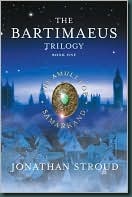
The Amulet of Samarkand by Jonathan Stroud

amulet

This long, involved, original and exciting fantasy is the first book of The Bartimaeus Trilogy, and is set in an alternate London, during a time when England is in the power of magicians who hold all government offices. The one dirty little secret that magicians don’t want the commoners to know is that on their own they have no power at all. What little power they do have is gained through the various demons (efrits, djinnis and other spirits) they summon and control with elaborate rituals and protections that force the demons into servitude.  Nathaniel is a boy who was sold by his parents at the age of six into apprenticeship to a pompous and stuffy mediocre bureaucrat, Arthur Underwood, who doesn’t see the boy’s exceptional talents. Underwood tutors Nathaniel in magic, but as the pace is so slow and boring, Nathaniel takes the initiative to advance his education behind his master’s back.  When he is ten Nathaniel suffers a very public humiliation by an up-and-coming politician Simon Lovelace. He takes revenge by using some of secretly gained knowledge to summon a powerful 5,000-year-old djinn named Bartimaeus. He instructs Bartimaeus to steal an artifact called the Amulet of Samarkand from Lovelace. Little does Nathaniel know that Lovelace himself stole the Amulet (and killed its original owner) and will stop at nothing to get it back. Lovelace has big plans for all of England that involve the Amulet (think overthrow of the government).  As if Nathaniel doesn’t have enough problems, he finds out that Bartimaeus has learned his real name, which makes it possible Bartimaeus to gain his freedom from Nathaniel, and to take his revenge on him. 

The story is told in alternating chapters: a third-person narrative about Nathaniel (not a sympathetic character by any means, being whiny and self-absorbed), and first-person by Bartimaeus, who is cynical, wise-cracking, and has an extraordinarily high opinion of himself. Bartimaeus’s chapters are filled with very funny footnotes explaining the finer points of magic, details about different planes of existence, types of demons, and the history of magic and the world. Don’t be tempted to skip the footnotes; they’re my favorite part of the book.  Review by Stacy Church

Wednesday, October 14, 2009

Stolen by Vivian Vande Velde

This book is not as scary as the cover makes it out to be; in fact, it’s stolen more a spooky mystery than a horror story. Isabelle’s first, and only, memory is of running in the forest and being chased by dogs. She’s not sure that her name is Isabelle, but one of the villagers is convinced that Isabelle is her daughter that was stolen by the witch of the woods six years earlier. Isabelle’s first memory does coincide with when the witch was hunted down and disappeared. Did she escape from the witch? If so, how come she doesn’t remember her family? Readers will be surprised by the unexpected ending.  Review by Katie Corrigan

Thursday, September 17, 2009

Notes from the Dog by Gary Paulsen

The things I didn’t like about this book mostly have to do with notes implausibilities.  I don’t really buy that a graduate student in her early 20’s would spend her money (if she had it) to pay a 14-year-old to spend the summer making a garden in his own backyard  (I have a 23 year old, so I do have some experience in this area).  I also don’t buy that someone who says about himself, “It’s not that I don’t like people, but they make me feel uncomfortable.  I feel like an alien dropped onto a strange planet and that I always have to be on the lookout for clues and cues on how to act and what to say…” would have as many different types of friends as Finn describes himself as having: Carl, who’s his best friend; Jamie, who’s his oldest friend; Christopher, his fun friend; and finally, Matthew, his only true friend.  Ok, now that we’ve got that out of the way, here are the things that I did like about the book.  It’s pretty funny, especially when Finn uses all of the fertilizer on his back yard because, if a little bit is good, a lot is better, and when he transplants poison ivy into the yard from the woods.  I like the parts about Dylan, the dog. “Dylan sat up as she got closer and looked at her with that teeth-baring border collie grin that scares people who don’t know that dogs can smile.”  And, when Finn starts getting anonymous notes, delivered by Dylan, “He pushed at my hand with his nose to get me to take the piece of paper from him and wiggled his whole body in excitement, as if he know what the words said.  Dylan’s a border collie, so the whole note thing is not as out-of-the-realm-of-possibility as it first sounds.”  The book is a good read about a teen dealing with death and mortality for the first time.  Review by Stacy Church

Thursday, September 10, 2009

Solving Zoe by Barbara Dee


There are two really interesting things about this book, and the first one is touched on so briefly that if you didn’t already know about synesthesia, you still wouldn’t know about it because the author never puts a name to it. Synesthesia is when a person’s sensory wires get sort of crossed, so they might, for instance, see a certain color when they hear a particular sound, or in the case of Zoe, see certain colors associated with particular numbers. I was so disappointed that the condition was never named, even though Zoe’s color/number association plays a part in solving an ancient cipher. And that’s the other interesting thing about the book: the plot revolves around codes and ciphers and the main character’s previously undiscovered natural talent for them. Other than that it’s a pretty good story, entertaining and kind of funny. For a great book about synesthesia, read A Mango-Shaped Space by Wendy Mass) Review by Stacy Church

Wednesday, September 02, 2009

Slob by Ellen Potter

Owen Birnbaum is above-average in two things: his IQ and his weight. slob He’s smart enough to know that he’s 57% fatter than the average 12 year old boy - not that his classmates, or gym teacher, would ever let him forget. He’s also really good at inventing things. One is a trap to catch a cookie thief, and the other involves outfitting his TV with a receiver to receive signals from the past. He’s trying to see a day two years ago that changed his life forever. As the story progresses, we learn what it is that Owen wants to see, why a certain store in the city makes him upset, and why he cherishes a piece of paper with the word “slob” on it.  Owen is a very likeable and real character. There are other likeable and interesting characters, like his sister who goes by the name Jeremy and joins the group GWAB (Girls Who Are Boys), and his Tibetan neighbor Nima, who gives him advice on his inventions and life. It’s been awhile since I read a book that was so funny and sad at the same time. This book will have wide appeal for boys and girls. Review by Katie Corrigan

Friday, August 28, 2009

Confetti Girl by Diana Lopez

confetti What a colorful cover!  The book begins with instructions for making cascarones, which are “festive, hollow eggshells, filled with confetti, that are cracked on people’s heads, scattering confetti all over the place and bringing everyone good luck!”  Each chapter begins with a dicho, or Spanish proverb, and the book is full of small bits of Spanish culture, which I really enjoyed.  Apolonia, or Lina, is a middle schooler in Texas, trying to get on with her life after the unexpected death of her mother the year before.  Her father, a high school English teacher, has retreated behind his love of books and words, and Lina feels as if that’s all he cares about.  The writing is sometimes stilted, and the reader is a little too outside the main character to be able to believe it when Lina stops doing her homework for English class, and blatantly makes up the answers on all of her quizzes, even though she knows that failing English will keep her from being able to play the sports that she loves.  She has constant squabbles with her best friend Vanessa, who has started to use Lina to cover up her relationship with her boyfriend (Vanessa’s mother doesn’t allow her to hang out with boys), and again, it’s kind of hard to “feel her pain.”  That said, it’s a fun book to read –the story is pretty good, and the characters are interesting.  Review by Stacy Church

Wednesday, August 19, 2009

The Roar by Emma Clayton

roar After the Animal Plague, the inhabitants of London built a wall around their city to keep the animals out and the people safe. Mika’s twin sister, Ellie, disappeared and is assumed dead, but Mika refuses to believe it. Things start getting strange when a new arcade opens up in town with an amazingly realistic flying game called Pod Fighter that all the kids become obsessed with. Soon there are Pod Fighter contests, with the winners being promised extravagant vacations and brand new houses. Mika advances in the tournaments, and finds himself in the final rounds, but it soon becomes clear that these contests are testing much more than the children’s abilities in pod fighting…  There have been quite a few futuristic children’s books published in the last couple of years, and this one stands slightly above the others. The action is steady throughout the book, and the dangers facing the children are original. There is some violence and the storyline is dark, so I don’t recommend this book for younger or sensitive children, but for fans of futuristic adventure stories, The Roar is a good bet. Review by Katie Corrigan

Thursday, August 13, 2009

Fashion Kitty and the Unlikely Hero by Charise Mericle Harper

fashion

This is the third book in the Fashion Kitty grahic novel series, and I enjoyed it just as much as the first two.  The illustrations are adorable, and the whole thing just makes me laugh.  Fashion Kitty is the secret identity of Kiki Kittie.  Kiki’s patience is tested when the principal of her school, Mrs. Rumple, decides that the students are spending too much time thinking about fashion (as if that’s possible), and too little time thinking about learning.  She decrees that they must wear uniforms to school (gasp!).  It’s a shock to Fashion Kitty when she appears at the home of fellow student Becky, and Becky politely declines her help.  That arouses Fashion Kitty’s suspicions, so she begins following Becky at lunchtime to find out what’s up.  Of course the solving of the mystery also results in the restoring of fashion at Kiki’s school. The book is also full of little truisms such as: It’s hard to be sad about your life and keep 2 big secrets all at once.  Review by Stacy Church

Thursday, August 06, 2009

Wild Things by Clay Carmichael

wild I really enjoyed this book, but retelling the plot won’t really explain why.  It’s another one of those books about a child who doesn’t know how to trust people because of the way people have let her down in the past, and yet on the surface Zoe seems to be a balanced character –she doesn’t treat her uncle (her new guardian) badly, or sulk endlessly in her room, or lash out at the kids or teachers at her new school.  It’s also a story about a man who’s never had children of his own, and yet he seems to know how to let a new child into his life –he’s not too strict or too private or too pushy.  The rest of the characters are interesting and not too stereotypical –there’s  a bully, but he turns out to have a soft spot for animals,  and there are some rich artsy snobs from New York, but there are also some rich artsy types from New York who turn out to be good friends.  I wasn’t too taken with the chapters written by the cat (who used to be feral until Zoe spent months winning him over).  There’s some suspense as the sheriff tries to figure out who vandalized the cabin in the woods that Zoe has made her own; there’s a white deer; there’s a wild boy; and some tense moments when someone or other is having a gun pointed at them.  Sounds like a good story to me.  Review by Stacy Church